Illustrated theatrical scene from Peer Gynt, evoking Ibsen’s play and Grieg’s music.

Grieg Ibsen illustrated concert companion

Peer Gynt: Illustrated Concert Suite

A visual and musical journey through Ibsen’s strange dramatic world and Grieg’s unforgettable score.

Grieg’s famous music began life inside Ibsen’s unruly, comic, dangerous and deeply human play. This illustrated guide restores the music to its dramatic world.

Prelude

The Story Behind the Suite

Henrik Ibsen is often called the father of modern drama. His most famous play is A Doll’s House, whose final door-slam became one of theatre’s defining images of individual freedom and social rebellion. But Peer Gynt, written earlier in 1867, is a very different kind of masterpiece: not a tight domestic drama, but a sprawling verse-play full of folklore, satire, fantasy, trolls, mothers, lovers, deserts, shipwrecks and spiritual reckoning. Its hero is not a noble adventurer but a brilliant evader — a man of imagination, charm and appetite who keeps turning life into performance rather than responsibility. In that sense, Peer Gynt is both a Norwegian folk-tale and an anti-heroic portrait of the self.

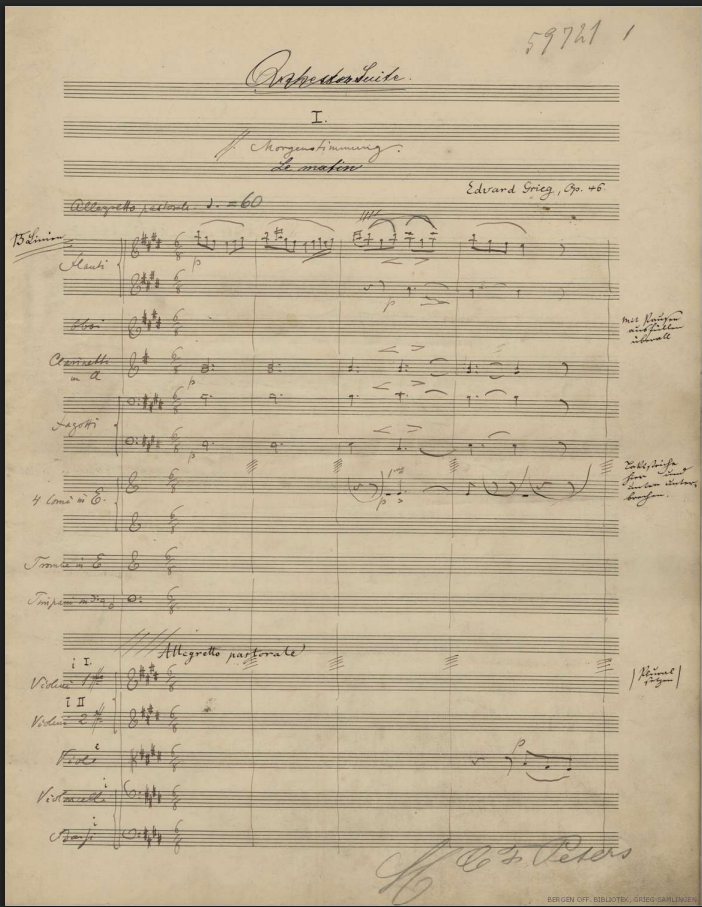
Edvard Grieg, Norway’s best-known composer, was invited by Ibsen in 1874 to write music for the play’s first staged production, which opened in 1876. Grieg later drew the most popular numbers into two concert suites, which is how audiences most often encounter the music today. But he was not only the composer of Morning Mood and In the Hall of the Mountain King: his wider output includes the famous Piano Concerto in A minor, the Holberg Suite, the Lyric Pieces for piano, songs, chamber music, and many works shaped by Norwegian folk melody and dance. In Peer Gynt, that gift for atmosphere becomes theatrical: Grieg can suggest a mountain kingdom, a deathbed, a sunrise or a dance with astonishing economy.

The play inside the music

Peer Gynt

Before the famous orchestral miniatures, there is a strange dramatic life: swagger, fantasy, tenderness, vanity and the question of whether Peer ever becomes real.

The play follows Peer Gynt from young manhood into old age. He begins in rural Norway as a swaggering fantasist, carrying off a bride from her wedding, disgracing himself and others, abandoning obligations, and escaping into the mountains. There he meets trolls, temptations and distorted versions of his own selfishness. Later he wanders across the world, becoming a trader, dreamer, seducer, false prophet and fraud, always remaking himself but never quite becoming a self. Behind the comedy and fantasy lies the central question of the play: what remains of a person who has spent his whole life dodging the truth?

Young Peer is brilliant, exasperating, full of invention, and already allergic to responsibility. He talks his way through life, making performance out of whatever should have become duty. Into that unsettled world comes Solveig — calm, sincere, and inwardly strong. She is not simply a love interest, but the play’s great counterpoint to Peer: where he evades, she remains; where he improvises, she endures; where he scatters himself across the world, she quietly keeps faith.

Throughout his life Peer boasts, improvises, seduces, bluffs, flees, reinvents himself, and refuses almost every hard claim that love, responsibility, age, grief, or truth might make on him. Ibsen’s play is not a straightforward fairy tale, even though it is full of trolls, mountain halls, desert scenes and dreamlike transformations. It is a life seen as a sequence of evasions: the young man who wants to be grand without becoming good, the son who loves his mother but keeps disappointing her, the wanderer who mistakes sensation and status for selfhood, and the old man who must finally ask whether there is anything real at the core.

Grieg’s music was written for Ibsen’s play, but most audiences now meet it through the concert suites, where the order has been rearranged. For this illustrated concert, we return the four familiar pieces to the order of the drama: first the grotesque temptation and panic of In the Hall of the Mountain King, then the intimate sorrow of his mother’s death, then the strange North African dawn of Morning Mood, and finally the glittering self-deception of Anitra’s Dance. That order matters. It turns the music from a set of attractive orchestral miniatures into a psychological journey: Peer is first swallowed by fantasy, then brought face to face with death, then released into a beautiful but morally ambiguous morning, and then drawn again into performance, vanity and desire.

Note on the concert order: Grieg’s Peer Gynt Suite No. 1 is usually performed in a different order. This illustrated concert follows the order of Ibsen’s play: first the troll hall, then Åse’s death, then the North African morning, and finally Anitra’s dance.

Each scene gives us a different kind of illusion. In the mountain hall, Peer is tempted by the troll world because it offers him everything without the cost of becoming fully human: appetite, power, indulgence, belonging, and the right to be “enough” to himself. In Åse’s death scene, illusion becomes more tender: Peer uses storytelling not to inflate himself, but to comfort his dying mother. In Morning Mood, nature itself seems to offer renewal, but Peer is still the same absurd, evasive man beneath the sunrise. In Anitra’s Dance, illusion becomes social and erotic theatre: Peer imagines himself a prophet and a great man, while Anitra sees jewels, opportunity and advantage.

Grieg’s genius is that he does not simply illustrate the stage action. He reveals the emotional truth underneath it. Hall of the Mountain King is built from repetition and accumulation, as if a whole mob-world is closing in around Peer. Åse’s Death strips almost everything away, leaving muted strings to say what Peer cannot say plainly. Morning Mood gives us one of the most radiant dawns in music, but its beauty is not simple innocence; it sits beside comedy, dislocation and self-deception. Anitra’s Dance sparkles lightly, almost weightlessly, because its charm is all surface: elegant, enticing, and not to be trusted too deeply.

So as you listen, follow two stories at once. One is the story on the surface: trolls, deathbed, sunrise, dance. The other is the deeper story of Peer’s self. He is always asking the world to confirm his fantasy of himself, and the music keeps testing that fantasy. Sometimes it mocks him, sometimes it mourns with him, sometimes it surrounds him with beauty, and sometimes it lets him be dazzled again. These four scenes are not the whole of Peer Gynt, but they give us the shape of the whole problem: how does a person become real, when he has spent his life being brilliant at escape?

Want to meet the characters first? Visit the Dramatis Personae.

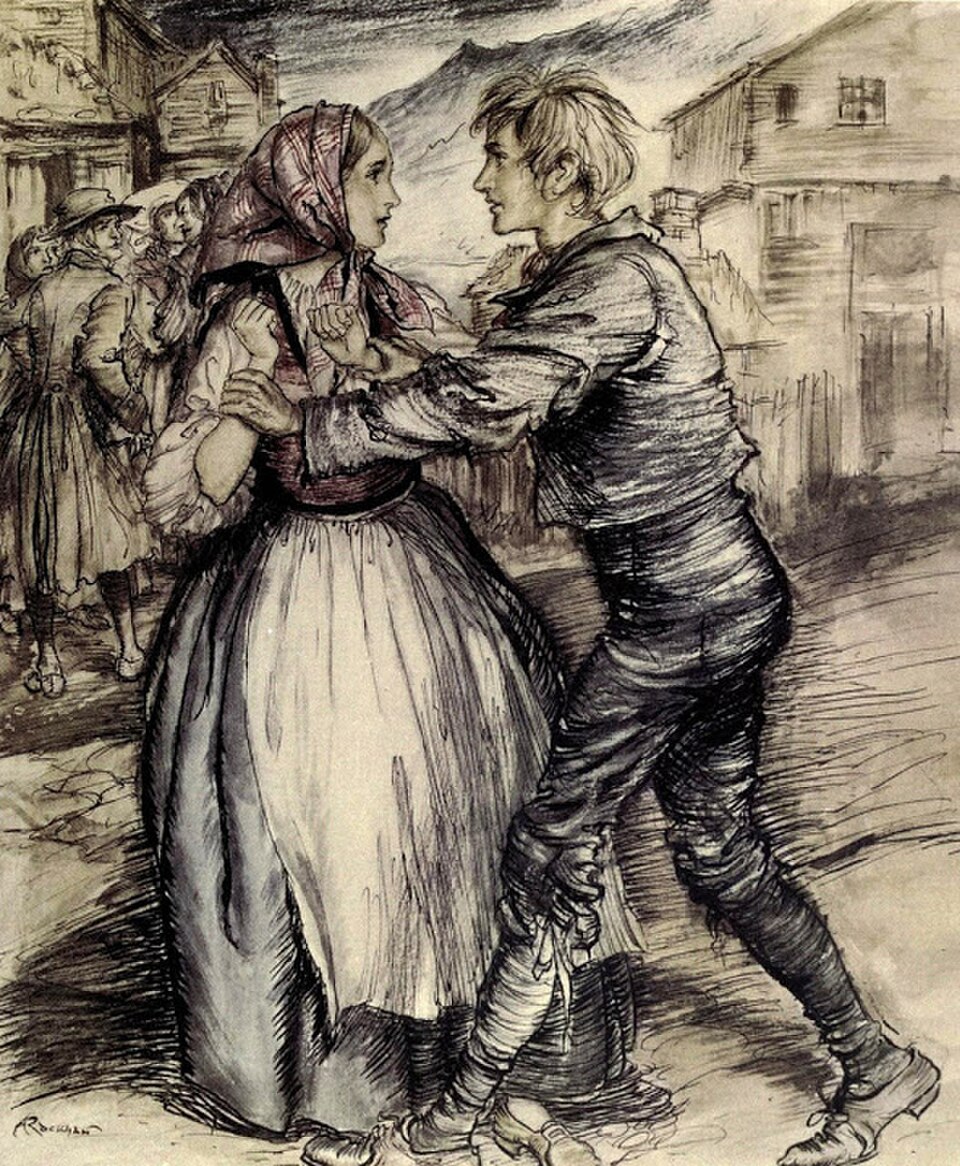
A small oval keepsake portrait of Solveig, modest, still and luminous.
Solveig, the still point in Peer’s fugitive life.

The concert sequence

The Illustrated Concert Sequence

Four famous pieces. Four scenes from a life of evasion, tenderness, beauty and self-deception.

Running order
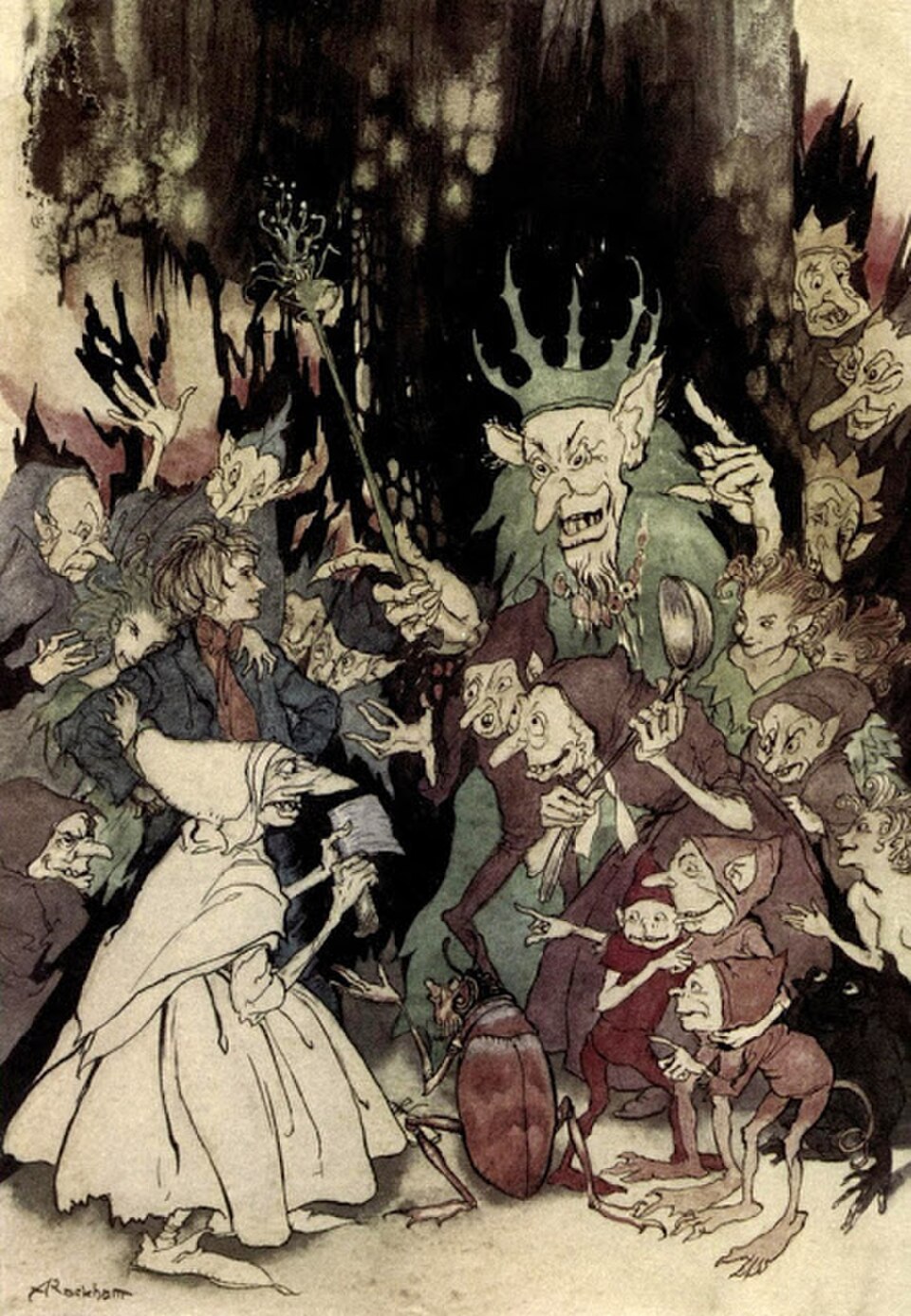
Peer Gynt surrounded by the Troll King and his court in a glowing underground hall, tempted by the troll world.
Temptation beneath the Dovre mountains: Peer courted by the troll world.

Scene I

Dramatic order · Movement IV in the usual Suite No. 1 sequence

In the Hall of the Mountain King

Peer enters the troll world beneath the Dovre mountains.

In this scene Peer has entered the troll world under the Dovre mountains. The Troll King is not simply threatening him; he is offering Peer a way of life. The troll motto is essentially: be sufficient to yourself, take the easy indulgent path, accept ugliness as beauty, and stop striving toward anything higher. That is why Peer should not look like a clean heroic outsider here. He is being courted. The trolls flatter him, surround him, offer him status, pleasure, treasure, belonging, and relief from moral effort. The danger is not that they will kill him at once, but that he might consent to become like them.

Grieg’s music captures this by beginning almost ridiculously quietly and simply. The famous theme starts low, sneaky, repetitive, and contained, as though something comic and grotesque is padding around in the dark. It is not noble danger; it is sly, grubby, creeping temptation. The same little phrase keeps coming back, almost obsessively, and that repetition matters: it feels like Peer being drawn further into a trap, not through one grand decision but through incremental surrender. The bassoon-like, low-register colour and the minor-key tread give the trolls their earthy, comic menace.

What to listen for is the accelerando and crescendo: the music keeps getting faster, louder, and more crowded until it becomes almost impossible to resist. This mirrors the troll court pressing in around Peer — first coaxing, then swarming, then overwhelming. The orchestration thickens, the accents become sharper, and the repeated theme turns from a sly invitation into a mob. This is the move from indulgent offer to engulfment: Peer sits at the centre, half-amused and half-changed, while the troll world closes around him. The music is funny, but it is also frightening because the joke is becoming real.

What to listen for

  • A low, quiet, almost comic beginning.
  • The famous theme returning obsessively.
  • Repetition becoming a trap.
  • The music getting faster, louder and more crowded.
  • The troll court moving from coaxing to swarming.
  • A joke becoming frighteningly real.
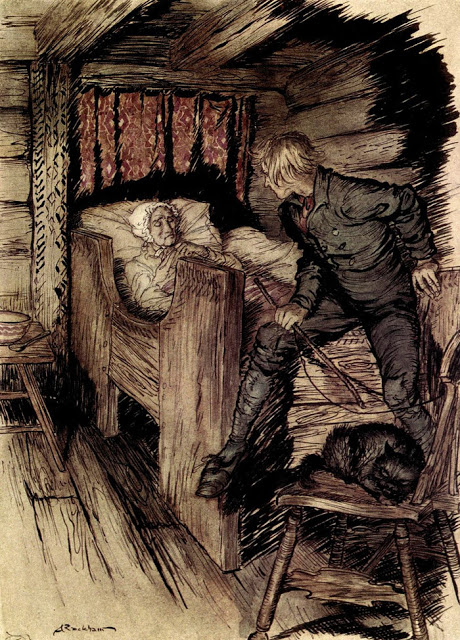
Peer sits beside his dying mother Åse in a candlelit cottage while a vision of Soria Moria glimmers behind them.
A dark cottage and the imagined golden road to Soria Moria.

Scene II

Dramatic order · Movement II in the usual Suite No. 1 sequence

Death of Åse

Peer turns storytelling, for once, into an act of mercy.

In this scene, Peer returns to the poor cottage where his mother Åse lies dying. But instead of confronting death directly, he does what he has always done: he tells a story. This time, though, his gift for invention is not a boast or an escape for himself. It becomes an act of mercy. Sitting beside Åse, Peer transforms the small, dark room into a journey toward Soria Moria, the golden castle of fairy tale, carrying his mother in words toward warmth, welcome, and release.

The illustration holds both worlds at once. In the candlelit cottage, Åse’s frail body remains grounded in the bed, her face worn by poverty, love, and exhaustion. Beside her, Peer leans forward, not as the swaggering adventurer but as a son trying to comfort his mother at the edge of death. Behind them, the vision of Soria Moria glimmers faintly: not a literal escape, but the story Peer is creating for her, a last kindness woven out of imagination.

Grieg’s music reflects this scene not with drama, but with restraint. Åse’s Death is a slow string lament, spare and sorrowful, built from long phrases that seem to breathe, rise, and fall. Listen for the way the music moves patiently toward a single emotional crest, then slowly withdraws, as though the room itself is growing still. The tenderness is in what is held back: the quiet pulse, the soft ache of the strings, and the final fading away.

What to listen for

  • A slow string lament.
  • Long phrases that breathe, rise and fall.
  • Restraint rather than melodrama.
  • A single emotional crest.
  • The music slowly withdrawing.
  • The final fading away.
Older Peer Gynt in a North African dawn landscape of palms and acacias after another of his illusions has collapsed.
North African dawn: beautiful, spacious, and not quite innocent.

Scene III

Dramatic order · Movement I in the usual Suite No. 1 sequence

Morning Mood

A beautiful dawn after another of Peer’s illusions collapses.

Morning Mood opens not in Norway, but in North Africa, where Peer Gynt finds himself after the collapse of yet another grand illusion. Betrayed, stripped of control, and left to face the vastness of the landscape alone, he emerges into dawn as if the world has begun again without him. Our illustration places the older Peer in that moment of fragile stillness: a wanderer moving through a radiant morning that is beautiful, but not innocent.

Grieg’s music captures this scene with extraordinary simplicity. The opening melody, first heard in the flute and then echoed by the oboe, seems to rise with the light itself. The orchestral texture gradually widens, as though the horizon is opening before us, until the music glows in one of its first great surges of brightness. This is sunrise not as spectacle alone, but as release: after panic, exhaustion, and disorientation, the world breathes out.

Yet Morning Mood is more than a landscape painting in sound. The serenity of the music stands in quiet tension with the man who hears it. Peer is not transformed; he is still evasive, self-dramatising, and spiritually unsettled. What Grieg gives us is something subtler and more moving: a moment in which nature is calm, luminous, and complete, while Peer, for a brief time, is small enough to stand inside it.

What to listen for

  • The opening flute melody.
  • The oboe echo.
  • The gradual widening of the orchestral texture.
  • The horizon seeming to open.
  • A surge of brightness.
  • The tension between serene nature and Peer’s unsettled self.
Anitra dances before an older Peer Gynt in a warm North African interior of lanterns, musicians and treasure.
Lamplight, music, treasure, and charm that never quite gives itself away.

Scene IV

Dramatic order · Movement III in the usual Suite No. 1 sequence

Anitra’s Dance

Peer meets charm, performance and another form of self-deception.

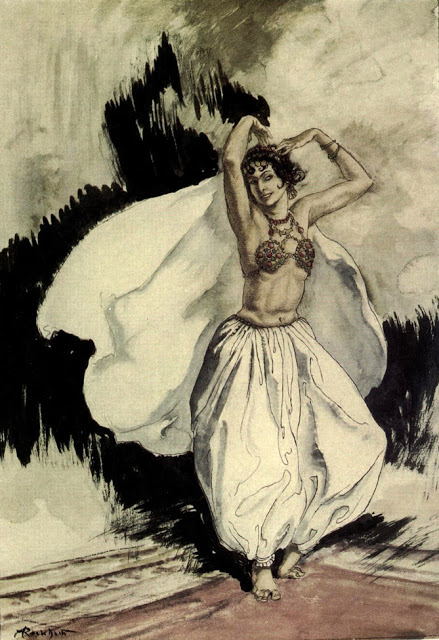
In this scene Peer is in North Africa, playing yet another role for himself. He has reinvented himself as a wealthy prophet-like figure, and for a while he enjoys the illusion. Anitra dances before him in a scene of warmth, luxury, music, and flickering lamplight. But this is not a sincere romance or a moment of deep connection. Peer is being entertained, flattered, and gently deceived. His vanity makes him vulnerable: he wants to be admired, desired, and believed, and Anitra understands that perfectly.

The illustration catches that mixture of seduction and danger. Peer reclines among cushions, treasure, fruit, and lanterns, older and more worldly than the young braggart of Norway, but still driven by the same appetite for fantasy. Anitra’s dance occupies the centre of the scene: graceful, glittering, controlled, and elusive. Around them, the musicians and attendants create an atmosphere of staged enchantment, while the darker figures in the background hint at what Peer does not yet see clearly — that this world is not simply offering pleasure, but taking from him while he is distracted.

Grieg’s music reflects this with wonderful lightness. Anitra’s Dance is not a huge sensual spectacle; it is delicate, pointed, and slightly ironic. The strings move with a small, teasing dance rhythm, while the triangle adds flashes of brightness, like jewellery catching the lamplight. Listen for the graceful lilt, the plucked textures, and the way the music seems to smile without ever quite giving itself away. It is charming, but also slippery: the dance dazzles Peer, and by the time the spell is over, the joke is on him.

What to listen for

  • Light, delicate orchestral writing.
  • Small teasing dance rhythm.
  • Plucked textures.
  • Triangle flashes like jewellery catching lamplight.
  • Graceful lilt.
  • A smile that never quite gives itself away.
  • Charm that is slippery rather than trustworthy.
Peer Gynt and Solveig in a quiet final reckoning with the Button-Molder nearby.
A quiet moral after-image: Peer, Solveig, and the question of the true self.

Closing reckoning

Faith, Hope and Love

The suite leaves Peer in the desert, dazzled by Anitra and still clinging to his illusions. But Ibsen’s play does not let him off so easily. The final act strips away every mask Peer has ever worn. Now an old man, stripped of his wealth by a shipwreck, he finally returns to the rocky shores of Norway.

There, he is confronted not by grand demons, but by a chilling figure: the Button-Molder, who tells Peer that his soul is to be melted down. Because Peer spent his life dodging choices—never being truly good nor truly wicked, always taking the easy way around—he has no core self. He is a defective button, a man who lived as a shadow. The tragedy of the “troll motto”—be sufficient to yourself—is finally revealed: by living only for himself, Peer has become nothing at all.

At the very end, his only refuge is Solveig, the woman he abandoned in his youth, who has waited for him in the mountains. When Peer asks her in despair, “Where was my real self all these years?” she answers simply: “In my faith, in my hope, and in my love.” Peer finally stops running, hiding his face in her lap as the play closes.

The four pieces of music of Grieg’s first Peer Gynt Suite do not take us all the way to that final, quiet reckoning. Instead, they capture the great, turbulent middle of Peer’s life. Grieg gives us the soundtrack to a man desperately trying to invent himself. Through the creeping temptation of the trolls, the tender grief of his mother’s deathbed, the vast indifference of a desert sunrise, and the empty glittering of a seduced prophet, the music holds up a mirror to Peer Gynt.

Grieg later drew a second set of numbers into the Peer Gynt Suite No. 2, Op. 55: The Abduction of the Bride and Ingrid’s Lament, the Arabian Dance, Peer Gynt’s Homecoming (a stormy evening at sea), and Solveig’s Song. It is performed far less often than the first suite, and none of its movements have lodged in popular memory the way Morning Mood or In the Hall of the Mountain King have. Yet it carries the quiet resolution the first suite withholds: Solveig’s Song is the very faith, hope and love in which Peer’s real self was kept safe all along.

And, as we listen to this brilliant, evasive man running from the truth, we are left to wonder how much of him we recognise in ourselves.

Live performance

Watch the Suite

A complete live performance of Grieg’s Peer Gynt Suite No. 1, gathered here as a final companion to the journey.

Programme notes

Credits